


Do you doubt that a session without equipment can really count as strength training? A day full of meetings, commuting and screens leaves little appetite for complicated machine settings. Yet strength training without equipment relies on very concrete mechanisms. Your own body mass, gravity and your points of support can already create measurable muscular effort.
November 20, 2026
Even Without Machines, Your Body Can Get Stronger
Your body can become a demanding source of resistance, even without equipment or a weight stack.
Do You Need a Machine to Create Real Resistance?
No. You can genuinely gain strength without using weight machines. Your muscles don’t recognize the equipment you use. They respond mainly to the mechanical tension they have to produce to resist, push, pull or stabilize.
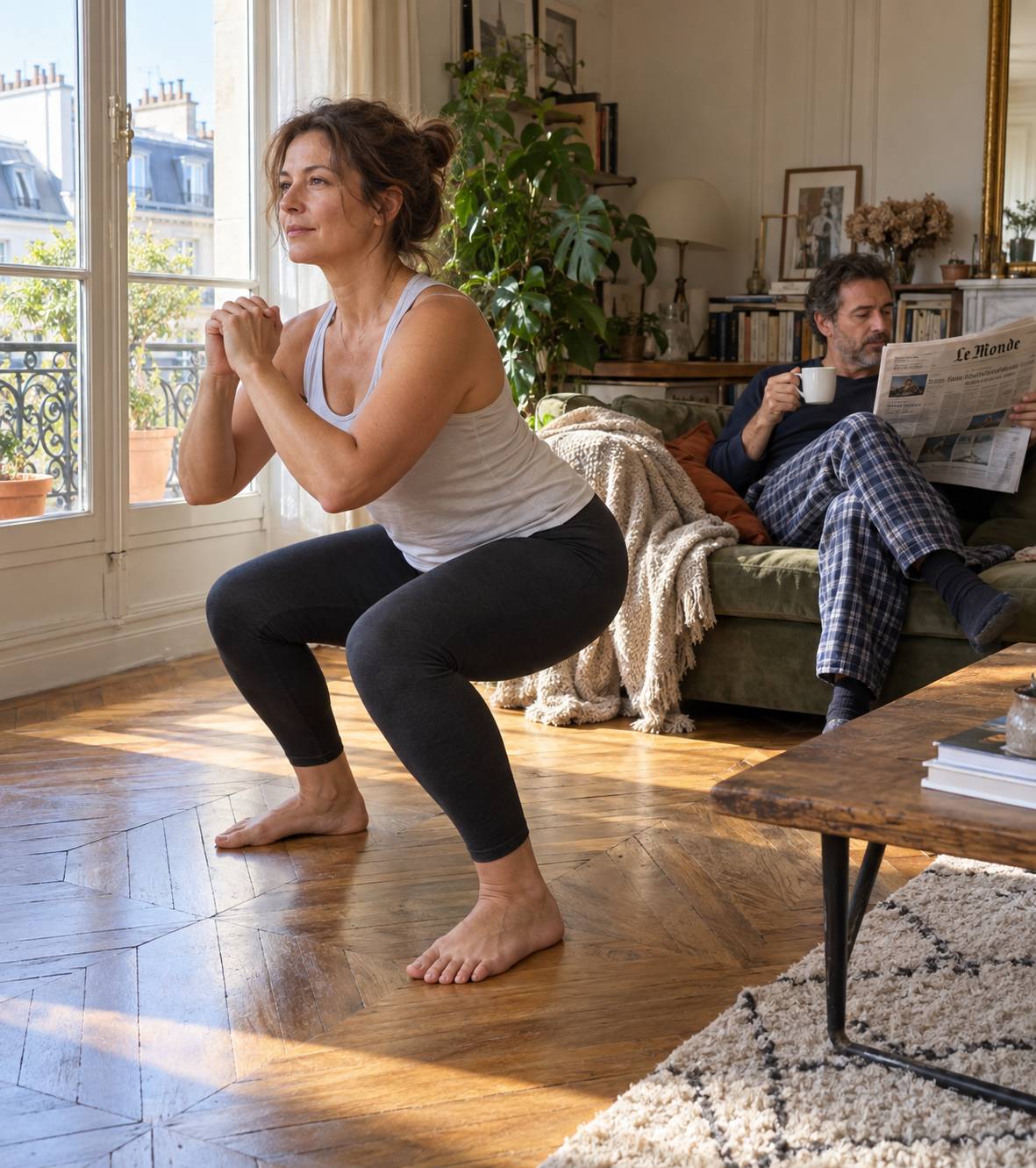
With bodyweight training, that resistance comes from your own mass and from gravity. Squats, push-ups, pull-ups or dips can therefore become true bodyweight strength exercises.
The key is to make each exercise progressively more demanding. You can slow down the lowering phase, increase the range of motion or change your points of support. You can also work one side at a time. A push-up with your feet elevated, for example, puts more load on the upper body.
You don’t need heavy equipment either. Resistance bands or suspension straps add progressive load while preserving a great deal of freedom of movement.
Your benchmark should stay simple. The last few reps should become hard without your form breaking down. It’s this progressive difficulty that pushes your muscles to adapt.
Why Does Strength Feel Different Without Machines?
Because your body has to produce force while stabilizing, balancing and coordinating several joints at once.
During a squat or a push-up, you never work just one muscle. Your core, hips, shoulders and various stabilizing muscles constantly adjust your position.
This way, you build strength that transfers more easily to everyday movements. Carrying groceries, climbing stairs quickly or getting up from the floor also require several areas of the body to work together at the same time.
Without a fixed path of motion, you also have to control your movement more. Your brain adjusts position, speed and balance with every rep. This neuromuscular coordination gradually improves your sense of where your body is in space.
I felt this very concretely. I no longer felt only able to push more. I felt more confident in my movements.
Another advantage: you can more easily adapt the range of motion and the orientation of your support points to your build. Look for a comfortable, controlled path, without forcing a painful joint.
This freedom does require precision, though. If your form starts to slip, reduce the range of motion before increasing the difficulty.
What Does the Body Work When No Machine Guides the Movement?
Without fixed support, your body has to stabilize every joint while it produces force.
First, your deep core muscles and lower back hold your pelvis and spine in place. They also transfer effort between your legs and upper body.
Around the joints, other muscles take over. The rotator cuff stabilizes the shoulder. The gluteus medius controls the pelvis and knee alignment. Your feet and ankles continuously correct your balance.
Your brain coordinates all these adjustments at once. As a result, you improve your proprioception and the coordination between several muscle groups.
Suspension and band exercises also place more demand on the hands, wrists and forearms. Don’t overlook this grip strength, which is valuable for carrying, pulling or holding on.
Tendons are also subjected to progressive loads. So increase the difficulty gradually to give these tissues time to adapt.
In an infrared cabin, the heat adds a complementary benefit. Your body reaches a feeling of warmth and mobility more quickly. This means you can get into the session faster. Still, keep your technique precise and hydrate regularly.

“Strength doesn’t depend on the setting, but on what your muscles actually have to produce.”
Spark Club · Paris 2nd & 16th
A 15- to 25-minute workout, in a private cabin
This guide is published by Spark Club, an infrared fitness studio in Paris: you work out alone or with one or two friends in a private infrared-heated cabin, and every session is guided on screen by a coach, with no group classes. Two clubs: Sentier (10 rue du Caire, Paris 2nd) and Trocadéro (8 rue Bellini, Paris 16th).
See the Discovery Pass
First visit €20, no commitment


