


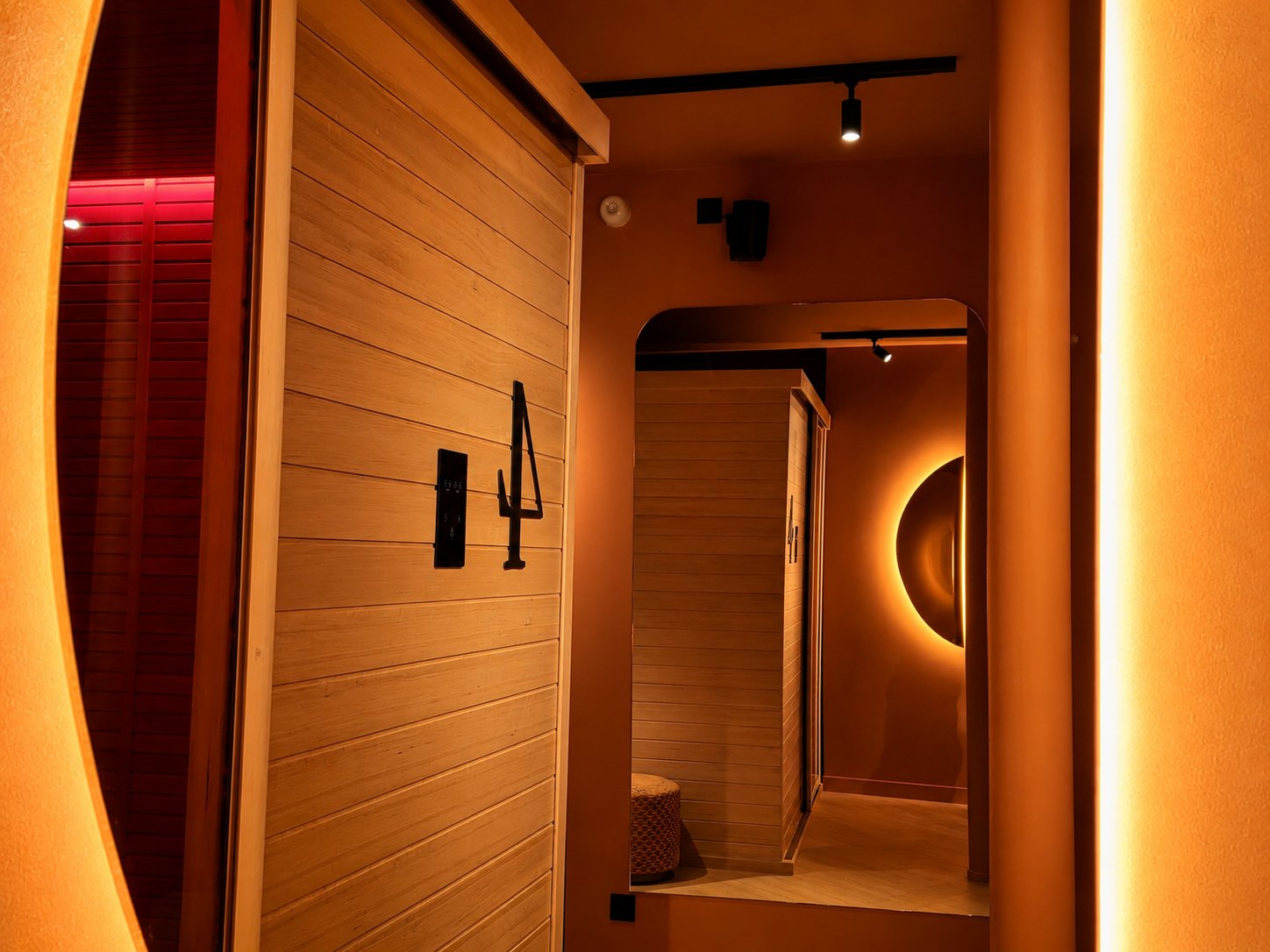
Exercising in an infrared sauna means training (yoga, Pilates, HIIT, cycling, rowing) in a cabin heated by infrared panels, at 40–45 °C in dry heat, in short sessions of 20 to 25 minutes. The heat shortens the warm-up, increases sweating and the sense of effort, and brings marked relaxation after the session. This guide, written by the team that opened the first infrared fitness clubs in France, explains what the practice does, what it doesn’t do, and how to start safely.
A Sauna Where You Move: The Definition
A traditional sauna heats the air to 70–100 °C; you sit still inside. An infrared cabin warms the body through radiation, in air at 40–60 °C depending on the setup (45 °C at Spark Club). At this air temperature, you breathe normally and can exert yourself physically: that’s what makes exercise possible in the cabin. The concept emerged in the United States in the 2010s with “hot yoga” studios and then cabin-based training; in France, Spark Club opened the first club with private infrared cabins in Paris 16 in 2025, followed by a second in Paris 2.
What Heat Changes About Exercise
Three effects are well documented in the physiology of exercise in hot conditions. First, heart rate rises faster for the same mechanical intensity: the heart works both for the muscles and to dissipate heat. Second, sweating starts earlier and more heavily: this is the body’s cooling mechanism, not a sign of “detox.” Finally, the sense of effort is higher: a 25-minute session in the heat feels harder than an identical session at 20 °C. These effects are described in detail in the review by Périard and colleagues (Physiological Reviews, 2021). They explain why the short format works: you don’t need an hour to feel that you’ve worked.
A fourth effect interests athletes: repeated training in the heat produces “acclimation,” which improves plasma volume and exercise economy, including afterward in temperate conditions (Lorenzo et al., Journal of Applied Physiology, 2010). This benefit was measured in trained cyclists and shouldn’t be applied as-is to everyone, but it is real.
What Research Says About the Infrared Sauna Itself
The literature on infrared saunas is thinner than on Finnish saunas, and it mostly covers passive sessions. A Canadian review (Beever, Canadian Family Physician, 2009) concludes that there are modest but consistent effects on blood pressure and endothelial function in small studies. A systematic review of 40 studies on dry saunas (Hussain and Cohen, 2018) reports generally favorable effects and few adverse effects, with study quality rated low to moderate. In Japan, “Waon therapy” (infrared sauna at 60 °C under medical supervision) improved vascular function in heart failure patients (Kihara et al., Journal of the American College of Cardiology, 2002): a clinical result, in a hospital setting, that cannot be extrapolated to a gym. The large population studies on mortality (Laukkanen et al., JAMA Internal Medicine, 2015) concern the traditional Finnish sauna, not infrared. Our position: infrared heat is a pleasant and reasonably safe wellness practice for a healthy adult; the solid health benefits come first and foremost from the exercise itself.
What the Cabin Doesn’t Do
It doesn’t “detoxify”: sweat is more than 99% water and salts, and eliminating toxins is the job of the liver and kidneys (Baker, Temperature, 2019). It doesn’t make you lose weight on its own: the weight lost during the session is water, regained with your first glass; what counts is the effort you put in inside the cabin and consistency. It replaces neither treatment nor medical advice.
Activities That Work in the Cabin
- Hot yoga: the heat increases suppleness, and held poses are more comfortable. The most natural format in a cabin.
- Pilates and Reformer Pilates: deep core work, with muscles warm from the first few minutes.
- Cycling and rowing: a complete cardio workout in 25 minutes, with a higher perceived intensity.
- HIIT: short intervals, best started at beginner level even if you’re athletic.
- Mobility and recovery: the session closest to a classic sauna, with the body moving slowly.
What a Session at Spark Club Looks Like
You book a private cabin, not a spot in a class. It is preheated to 45 °C before your time slot. On screen, a coach guides the 25-minute session: warm-up, main workout, cool-down. You’re alone (or with one other person), with no mirror and no one watching. A shower, towels and cool water await you when you come out. The two Paris clubs are at 8 rue Bellini (Trocadéro, Paris 16) and 10 rue du Caire (Sentier, Paris 2); the Discovery Pass at €20 covers a first visit.
Precautions: Who Should Seek Medical Advice
Heat increases the heart’s workload and water loss. Ask your doctor before a first session if you are pregnant, or if you have cardiovascular disease, low blood pressure, a chronic condition or a treatment that affects thermoregulation. For everyone: drink before and after, avoid alcohol before the session, start with a gentle session, and leave the cabin if you feel dizzy or nauseous. Under-18s are not admitted to the heated cabins.


