


You can follow the same program diligently and no longer get the same response from your body. Your body learns to perform a familiar effort more efficiently, while your daily routine also changes your total energy expenditure. Changing your training program makes sense when several signs point the same way, not as soon as the scale wavers. The real question is which signs.
November 20, 2026
Your Training Program: Signs It’s Time to Change It Up
An effective program isn’t the one you repeat for a long time, but the one that actually keeps you progressing.
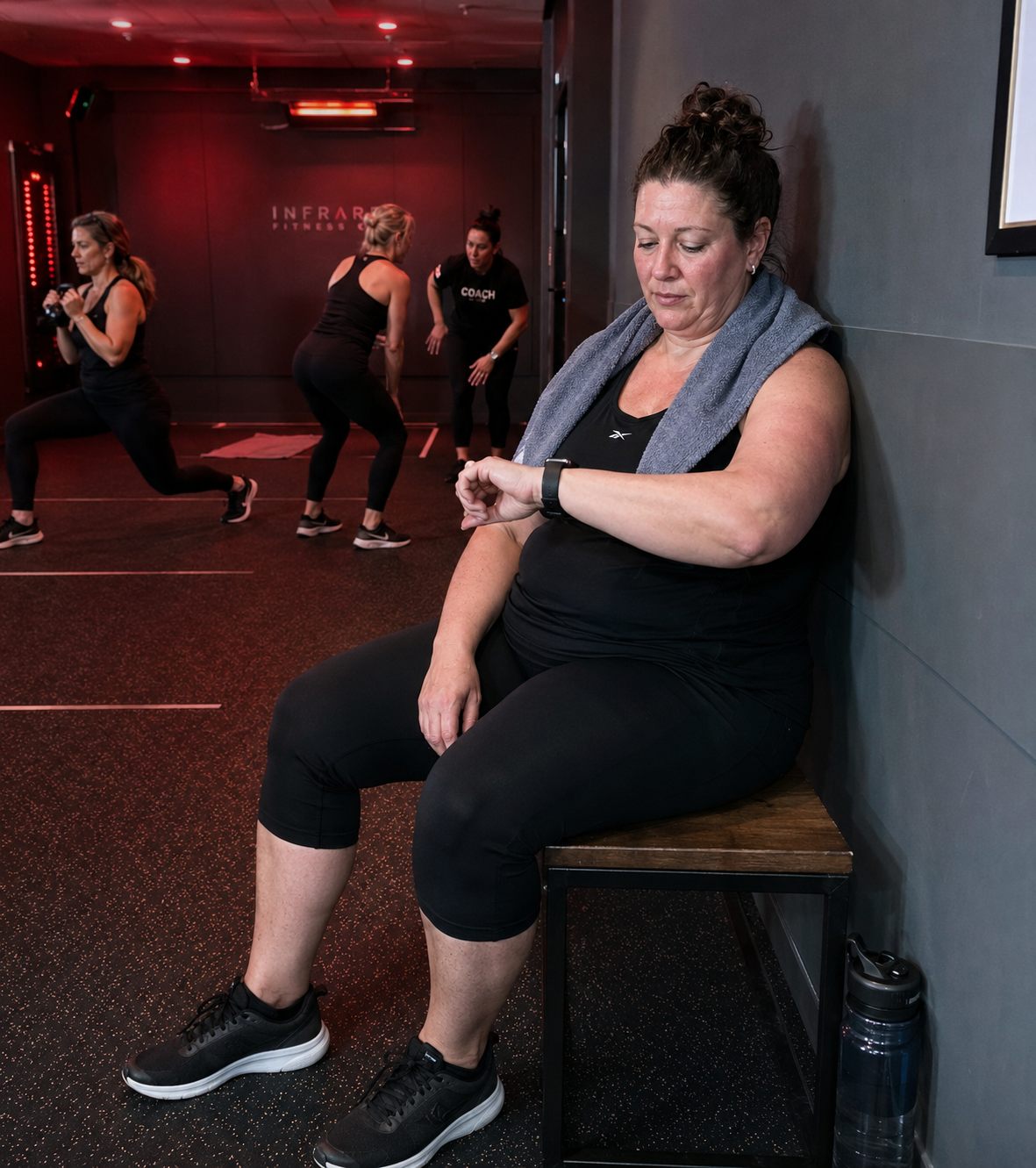
How Can You Tell If Your Body Has Adapted to Your Program?
Reassessing your infrared training program every four to six weeks can make sense, without turning it into a hard-and-fast rule.
Your physical progress levels off
Stable weight and measurements for two to three weeks deserve your attention, especially if your habits haven’t changed much.
Look at your performance too. If your heart rate climbs less for the same speed or resistance, your fitness has improved. That means your program can evolve.
The absence of muscle soreness, on the other hand, isn’t enough. An effective workout doesn’t have to hurt the next day. Rely more on how hard the session actually is, your measurements and your ability to sustain the effort.
The heat becomes much easier to tolerate
After several weeks in an infrared cabin, a temperature that once felt demanding may seem much more comfortable. Your heart rate rises less, and you quickly return to your usual state after the session. This is a normal adaptation to exercise and heat.
How much you sweat is less useful to track. Hydration, outdoor temperature or your menstrual cycle can change it. If your cabin is set between 30 °C and 55 °C, don’t automatically look for more heat. Instead, progress the exercise: resistance, incline or interval length.
Your session barely feels like effort anymore
Boredom often comes with a more concrete clue. You finish your exercises with a lot left in the tank. On the treadmill, bike or floor exercises, the last few reps should still require focus.
If you could easily extend every set, your program probably isn’t challenging enough anymore. You can then change just one variable: slightly increase the resistance, change the incline, extend an interval or introduce a new exercise.
This gradual progression keeps your infrared training program worthwhile without turning every session into an ordeal.
How Can You Evolve Your Program Without Starting From Scratch?
You don’t need to rebuild your program every time you hit a plateau. Step-by-step progression means keeping your benchmarks while changing one variable precisely enough to create a new challenge.
Gradually increase the difficulty on machines
On a bike or elliptical, add one or two resistance levels when your usual setting becomes too easy. On a treadmill, a 3 to 5% incline increases the effort required and works the posterior chain more, especially the glutes.
In an infrared cabin, however, avoid raising the temperature just to burn more calories. More heat mainly increases thermal stress.
To progress, focus first on resistance, speed or incline. That way, you control exactly how much effort you’re adding without making the session needlessly more grueling.
Change the pace with intervals
You can keep the same machine and change the structure of your session.
A 30/30 format alternates 30 seconds of hard effort with 30 seconds of active recovery. The effort should stay intense but controllable, rather than always all-out.
You can also use a pyramid. Gradually increase the intensity every minute for five minutes, then come back down in steps. These variations force your body to respond to several levels of effort within the same session.
In an infrared cabin, start cautiously. The heat already adds cardiovascular strain to the exercise.
Increase density without lengthening the session
When your schedule leaves no room for longer sessions, slightly increase the amount of work done in the same time.
For strength or Pilates exercises, you can gradually reduce a rest period from 60 to 45 seconds, then possibly to 30 seconds.
Another option: add two or three reps to a set that has become easy. Don’t change both parameters at the same time. You need to maintain clean form. This approach makes your program more demanding without adding a new session to your week.
Progress the movements you’ve mastered
A familiar exercise can remain useful if you increase its difficulty intelligently. Resistance bands can add challenge to a squat, a glute bridge or certain Pilates movements.
You can also choose a variation that requires more control or range of motion. A classic squat can progress to a squat with a calf raise before you consider a jump version. A static plank can become dynamic with slow leg movements.
In infrared heat, focus above all on the quality of your movement. More complex doesn’t automatically mean more effective if your form breaks down.
Your program doesn’t need an overhaul to stay effective. A few well-chosen adjustments are often enough to restart your progress.
In Practice, in Paris
At Spark Club, these guidelines apply to both infrared cabin session formats: 15 minutes of cycling or rowing, or 25 minutes of strength training, HIIT or Pilates, guided on screen.

“A good program evolves before it becomes a habit your body performs without any negotiation.”
Spark Club · Paris 2nd & 16th
A 15- to 25-minute workout, in a private cabin
This guide is published by Spark Club, an infrared fitness studio in Paris: you work out alone or with one or two friends in a private infrared-heated cabin, and every session is guided on screen by a coach, with no group classes. Two clubs: Sentier (10 rue du Caire, Paris 2nd) and Trocadéro (8 rue Bellini, Paris 16th).
See the Discovery Pass
First visit €20, no commitment


